 TAK Technology
Antenna & resonance — antenna rods, RFID, high-Q inductors
Antenna rods and high-Q inductors are open magnetic circuits; the high resistivity of NiZn keeps them low-loss and stable into the MHz range. Each grade has its own high-Q band (around the minimum of its loss factor); choose along the μi ladder by operating frequency.
- LAntenna rod / resonant inductorOpen magnetic circuit; choose by Q and temperature stability; M9A/V2F1 for 13.56 MHz NFC
Band → material
Suggested shapes
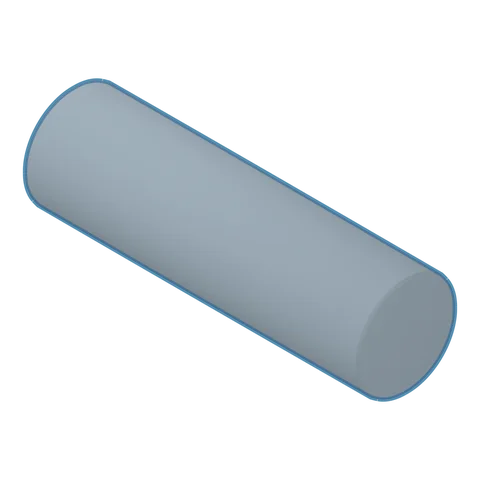 3D · illustrativeR antenna rodChoose a series ▾
Strengths
- Open magnetic circuit, suited to sending and receiving magnetic fields (antennas, sensing, tuning)
- Simplest structure, easy winding
Trade-offs
- High leakage flux; watch EMI
- Inductance limited by the open magnetic circuit
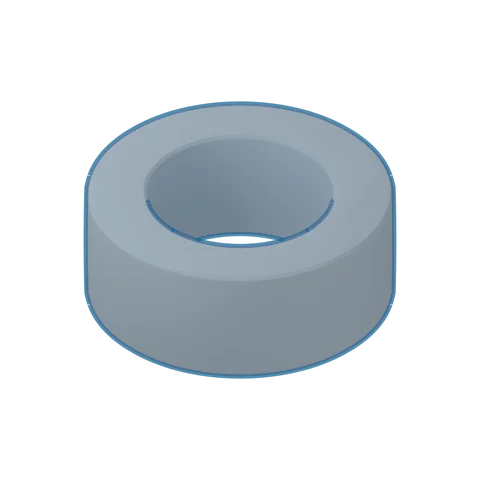 3D · illustrativeToroid TChoose a series ▾
Strengths
- Closed magnetic path without joints or air gap: highest magnetic efficiency
- Good self-shielding, low leakage flux
- Lowest core cost, no bobbin needed
Trade-offs
- Winding must be threaded through the hole; high winding cost
- Less convenient to mount on the PCB
- No air gap; for storage inductors use a combination shape whose gap can be ground
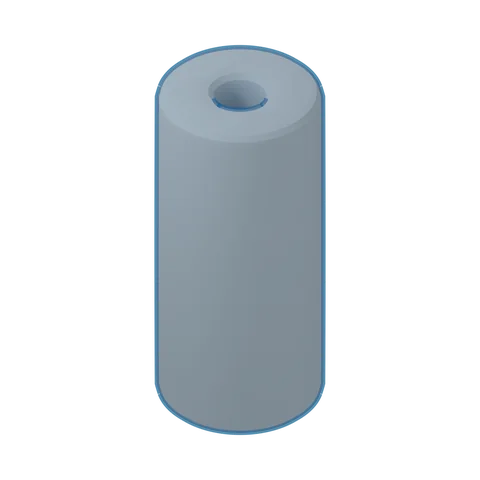 3D · illustrativeRHChoose a series ▾
Strengths
- Slips straight over a conductor or lead; no bobbin, simplest to fit
- For EMI suppression on cables/leads
Trade-offs
- Mainly threaded onto a conductor, not used as a wound inductor
- The suppression band depends on the material; choose the grade by band
 3D · illustrativeDRChoose a series ▾
Strengths
- Open magnetic circuit, withstands DC bias
- Simplest winding
- Can be paired with an SP/SRI shield cap to reduce leakage flux
Trade-offs
- High leakage flux when used alone; watch EMI
- Inductance limited by the open magnetic circuit
Where it goes
Matching inductors for RF and wireless modules
Automotive RF, keyless-entry antennas
RFID readers, radio antenna rods, high-Q inductors